

Model-based Medicine and Intelligent Operating Room
Head: Prof. Dr. Thomas Neumuth
Modern medicine is no longer conceivable without the use of technology: medicine, information management and biomedical technology converge to an ever greater extent. This development requires traditional medical devices to be combined with information and communication technology.
Teams
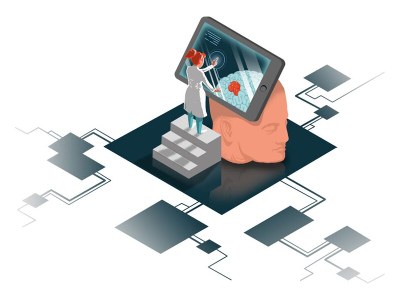
Clinical Workflows and Integrated Assistance Systems
Research focus: Model-based Medicine and Intelligent Operating Room
Team lead: Juliane Neumann, Erik Schreiber
The team develops concepts, methods and digital tools to improve the efficiency, safety and quality of healthcare, reduce costs and risks, and reduce the workload of medical staff. A central aspect is the modelling, analysis and optimization of clinical workflows – using business process modeling, data analysis and simulation techniques.
In addition, the team develops integrated assistance systems combining artificial intelligence, machine learning and sensor-based applications: for example tools for identifying shortcomings of digital systems in everyday clinical practice, aggregating study data from digital and paper-based sources, sensor-based gait analysis for predicting falls, and real-time decision support in critical situations. Another focus is the integration of these systems into existing workflows and IT structures.
Projects
-
SurgiTrace AI-based system for optimizing surgical planning and enhancing perioperative safety through intelligent tracking of instruments and implants
AI-based system for surgical planning: a smart implant cabinet dispenses endoprostheses automatically and a tablet application verifies completeness, product type and size – enhancing efficiency and patient safety.
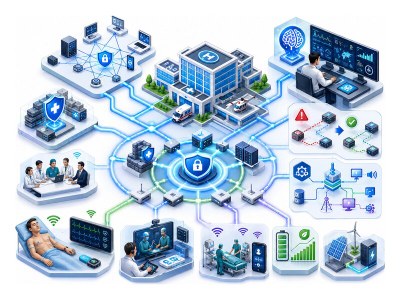
Connected Health: Next-Generation Medical Networks
Research focus: Model-based Medicine and Intelligent Operating Room
Team lead: Tobias Pabst
Members: Alexander Prull, Anna Schatz, Christoph Georgi, Clemens Möllenhoff, Gregor Thürk, Ken Paulitz, Misha Justen
The team addresses the demands that increasingly networked medical technology places on communication technology: it identifies areas of application and selects suitable technologies – always with clinical benefit as the starting point and in collaboration with partners from industry and academia. Key areas of focus include mobile communications (5G/6G/campus networks), interoperability standards (HL7 FHIR, IEEE 11073 SDC), augmented and virtual reality, model-based approaches for the smart hospital, and positioning technologies (BLE, UWB, 5G).
In collaboration with the UKL’s clinical departments, including ENT and Trauma Surgery, as well as other clinical departments in Germany, patient journeys are being developed to better understand clinical needs, and demonstrators are being created to bring new technologies to life. Examples include immersive teleconsultations, mobile ultrasound at the point of care using edge computing, wireless sensors for the early detection of healing complications following surgery, and new spatial concepts enabled by intelligent networking within the hospital.
Projects
-
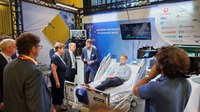 6G-Health Holistic development of high-performance 6G networking for distributed medical technology systems
High-performance 6G networking for distributed medical technology: in 2025 the infrastructure for tele-neuromonitoring, a testbed with three indoor localization technologies and a “patient room of the future” at the 6G Conference in Berlin were realized.
-
 KliNet5G Clinical networks via 5G
Secure, standards-based 5G campus networks (Open RAN) for hospitals – with measurement campaigns, SDC alarms in network management and assessment of reliability, IT security and economic viability; part of the BMWK-funded CampusOS framework.
-
QoE Development of a system for Quality of Experience in telemedical data exchange
Quality of experience in telemedical data exchange: video, vital signs and ECG data are prioritized in real time based on network quality and the clinical context – for example in ambulances.
-
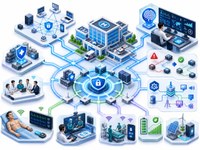 SUSTAINET-guarDian Sustainable Technologies for Advanced Resilient and Energy-Efficient Networks – guided utilities for automation, resilience, and digital innovation in advanced networks
Secure, resilient and energy-efficient networks for healthcare with AI-supported network monitoring and fault detection; ICCAS is responsible for the medical demonstrator.
Completed projects (1)
-
MIRACLE-5 until 06/2025 Mixed-Reality Integrated Remote Assistance and Communication in 5G-Enabled Local Environments
XR-based telemedicine via 5G campus networks – for geriatric assessments after hip fractures, ENT teleconsultations, ENT teaching and remote medical advice. In 2025 an open 5G core was installed, test networks were established, and the scenarios were evaluated with the ENT department of Leipzig University Hospital and compared with Wi-Fi.
Digital Patient Model
Research focus: Model-based Medicine and Intelligent Operating Room
Team lead: Dr. Stefan Franke
Members: Max Schreiber, Jean-Baptiste Tylcz, Adrian Lindenmeyer, Erik Schreiber, Nora Grieb, Johannes Keller, Richard Steinert
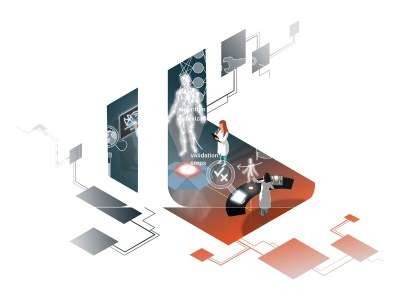
The “Digital Twins” research group develops methods for digital images of patients to enable AI-supported healthcare. Digitization and interoperability for location- and device-independent access to clinical data play a central role: many AI-based methods require structured patient data, but the lack of standardized interfaces, the high complexity of clinical IT ecosystems and the requirements for data protection and security are major hurdles.
The Medi.NET project creates a network of clinics, research institutions and companies, with a transfer office and a technical platform for virtual twins. In the EU project CERTAINTY, the group develops infrastructure, interfaces and models for personalized cancer therapy – with a virtual twin to support the treatment of multiple myeloma.
Projects
-
Medi.NET Intelligent Digital Platform for Location- and Time-Independent Medicine of the Future
Intelligent digital platform for location- and time-independent medicine: interoperable infrastructure based on IEEE 11073 SDC and HL7 FHIR, demonstrator and test environments, and a partner network of more than 80 actors; coordinated by ICCAS.
-
 CERTAINTY A Cellular Immunotherapy Virtual Twin for Personalized Cancer Treatment
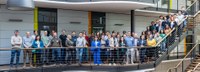
Virtual twin for personalized cancer treatment, focusing on multiple myeloma and CAR-T cell therapy; ICCAS implements the virtual twin backend and frontend.
-
NFDI4DS NFDI for Data Science
National research data infrastructure for data science and AI; ICCAS leads the biomedical use cases within the consortium.
-
 DaDriv-StAC Digital Platform for Data-Driven Decision Support in Post-Stroke Care
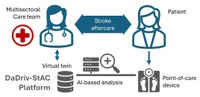
Digital platform for data-driven decision support in post-stroke care: a virtual medical twin compares the recommended care pathway with the actual course of treatment across sectors.
Smart Clinical Assistance: Decision Support
Research focus: Model-based Medicine and Intelligent Operating Room
Team lead: Maximilian Ferle
Members: Nora Grieb
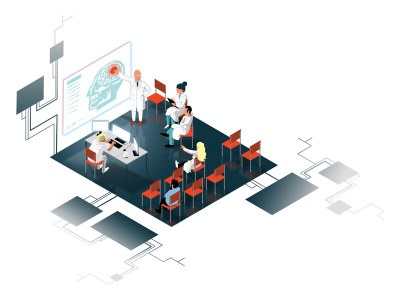
Our research team focuses on the analysis and modeling of blood cancers such as multiple myeloma (MM) and related diseases such as myelodysplastic syndrome (MDS) and acute myeloid leukemia (AML). In close cooperation with the Department of Hematology, Cell Therapy, Hemostaseology and Infectiology at Leipzig University Hospital, we develop data science and machine learning methods that make precise predictions about disease progression and therapy success – providing physicians with data-driven decision support for individual therapy decisions.
Projects
-
VOLTA Validation Of Model-Based Therapy Decision Support in Hematology
Validation of model-based therapy decision support in hematology: KAIT, the platform for multiple myeloma developed with the hematology department at Leipzig University Hospital since 2020, is being expanded, tested and optimized for routine practice.
-
GenoMed4All
EU-wide network for exchanging clinical and multi-omics data via federated learning for hematological diseases; ICCAS contributes data integration and standardization based on HL7 FHIR.
-
 LENS (ScaDS.AI-Seedfunding) Learning Engine for Novel Survival-clustering (ScaDS.AI seed funding)
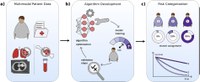
Learning Engine for Novel Survival-clustering: a model-agnostic method that finds prognostically distinct patient groups – pioneered on multiple myeloma data and CT images of non-small cell lung cancer.
Smart Clinical Assistance: Emergency Management
Research focus: Model-based Medicine and Intelligent Operating Room
Team lead: Jan Gaebel
Members: Hector Condori Alagón, Alexander Holzenleiter, Marcel Zill
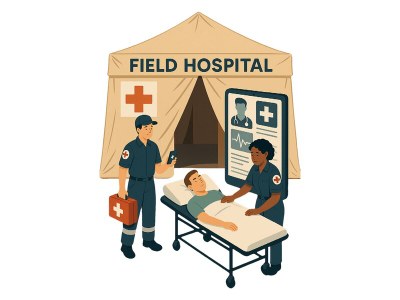
The group develops digital tools and process assistance for emergency and intensive care – on an interdisciplinary basis, combining technical expertise with medical know-how and in close collaboration with end users such as aid organizations and authorities.
One example is the EOS software (EMT Operating System) in the EU project RescEU EMT, which strengthens civil protection capacities in Europe with mobile Emergency Medical Teams (EMTs). EOS supports mission coordination, patient management and data analysis in crisis situations and is continuously adapted to the needs of emergency services using agile, user-centered methods.
Projects
-
 RescEU EOS Emergency Medical Team Operating System
Field hospital information system: supports patient treatment from triage to discharge, department configuration, key performance indicators and reporting (e.g. to local government or WHO).
-
Tele-KAI Creation of a virtual intensive care treatment center through implementation of a tele-intensive care infrastructure
Tele-intensive care at the Department of Anaesthesiology and Intensive Care at Leipzig University Hospital: makes intensive care expertise available across distances and enables targeted, resource-adapted patient transfers.