

Connected Health: Next-Generation Medical Networks
6G-Health
Holistic development of high-performance 6G networking for distributed medical technology systems
High-performance 6G networking for distributed medical technology: in 2025 the infrastructure for tele-neuromonitoring, a testbed with three indoor localization technologies and a “patient room of the future” at the 6G Conference in Berlin were realized.
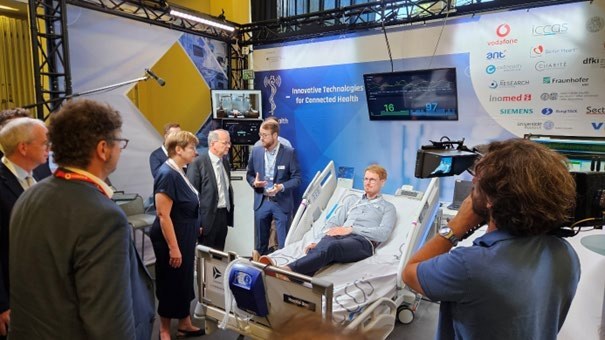
The 6G-Health project brings together the domains of communications engineering and medical engineering, along with medical and technical end users, to enable tailored technology development in the field of sixth-generation mobile communications (6G). The project not only develops specific 6G technology components, but also identifies market-entry barriers at an early stage and develops possible countermeasures. These primarily include aspects of approval, operation, and standardization. Within the project, UML sees its role as a mediator between the domains of medicine, communications engineering, and medical engineering, addressing not only the technical applications but also the requirements arising from standardization and operation. At the technical level, the focus is on collaborative work and the field of “Smart Hospital”. In the 2025 reporting year, substantial results were achieved in three key areas:
Teleneuromonitoring: The technical infrastructure for the remote monitoring of neurosurgical procedures has largely been established. Medical devices can now be integrated into the transmission chain in compliance with standards via SDC and FHIR, and data can be transmitted with prioritization. Based on clinical interviews with surgeons and IONM specialists, a medically evaluated dashboard concept was developed that enables remote experts to monitor several operating rooms simultaneously, including a complete neuromonitoring, anesthesia, and transcription view. Implementation as an operational demonstrator is planned for 2026.
Smart Hospital and indoor localization: Three different real-time localization technologies – UWB from NXP, BLE AoA from the University of Rostock, and BLE RSSI multilateration – were harmonized for the first time via a shared MQTT middleware and successfully put into operation in the ICCAS testbed. The results were documented in a comparative paper. This provides the basis for the automated tracking of patients, staff, and devices in clinical environments.
Visibility and transfer: The consortium presented itself at the 6G Conference Berlin with one of the largest joint exhibition booths at the event. For the first time, the specific medical added value of 6G was demonstrated to the public using a complete patient journey, with the participation of almost all project partners. In addition, UML was represented at DMEA, the 6G Summit Dresden, and the ThinkNet 6G Summit in Nuremberg.
More projects of the team
-
 KliNet5G Clinical networks via 5G
Secure, standards-based 5G campus networks (Open RAN) for hospitals – with measurement campaigns, SDC alarms in network management and assessment of reliability, IT security and economic viability; part of the BMWK-funded CampusOS framework.
-
QoE Development of a system for Quality of Experience in telemedical data exchange
Quality of experience in telemedical data exchange: video, vital signs and ECG data are prioritized in real time based on network quality and the clinical context – for example in ambulances.
-
 SUSTAINET-guarDian Sustainable Technologies for Advanced Resilient and Energy-Efficient Networks – guided utilities for automation, resilience, and digital innovation in advanced networks
Secure, resilient and energy-efficient networks for healthcare with AI-supported network monitoring and fault detection; ICCAS is responsible for the medical demonstrator.
Back to the team Connected Health: Next-Generation Medical Networks