

CERTAINTY
A Cellular Immunotherapy Virtual Twin for Personalized Cancer Treatment
Virtual twin for personalized cancer treatment, focusing on multiple myeloma and CAR-T cell therapy; ICCAS implements the virtual twin backend and frontend.
CERTAINTY develops a clinical Virtual Twin (VT) framework to support individualized, transparent, and evidence-informed decision-making in oncology. A central use case is Multiple Myeloma, with particular attention to complex therapeutic pathways such as CAR-T cell therapy. Multiple Myeloma is a type of blood cancer with many possible courses and treatment options, and CAR-T cell therapy is a highly specialized treatment that can be effective but also requires careful decision-making because eligibility, expected benefit, timing, side effects, and patient preferences all need to be weighed together. The VT is intended to bring together patient-specific clinical information, medical knowledge, predictive models, and interactive software components in order to make treatment options, expected outcomes, risks, and uncertainties more accessible and understandable.
The project aims to support clinicians in assessing possible treatment pathways and communicating relevant information in a structured and traceable way. At the same time, the VT concept considers how patients may be involved more actively, for example through comprehensible visualizations of treatment options and the reporting of symptoms, experiences, and outcomes.
ICCAS contributes to CERTAINTY by implementing the Virtual Twin backend and frontend components. This includes the technical foundation required to connect data, models, user interfaces, and clinical workflows into an integrated VT environment. Through this work, ICCAS supports the transformation of the CERTAINTY concept into a usable software system for clinical and patient-related applications. The work has advanced from conceptual development towards the realization of the Virtual Twin environment; the Multiple Myeloma use case and the CAR-T treatment context provide the clinical focus for shaping the VT’s functionality and user interaction.
Current results include an increasingly defined VT architecture, initial frontend concepts for clinician-facing and patient-facing interaction, and backend structures that enable the integration of relevant information and computational components. The emerging system is designed to support clear presentation of therapeutic alternatives, CAR-T-related decision factors, expected benefits, possible adverse events, and uncertainties – making complex oncological decision-making more transparent, individualized, and usable in realistic clinical settings.
More projects of the team
-
Medi.NET Intelligent Digital Platform for Location- and Time-Independent Medicine of the Future
Intelligent digital platform for location- and time-independent medicine: interoperable infrastructure based on IEEE 11073 SDC and HL7 FHIR, demonstrator and test environments, and a partner network of more than 80 actors; coordinated by ICCAS.
-
NFDI4DS NFDI for Data Science
National research data infrastructure for data science and AI; ICCAS leads the biomedical use cases within the consortium.
-
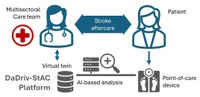 DaDriv-StAC Digital Platform for Data-Driven Decision Support in Post-Stroke Care
Digital platform for data-driven decision support in post-stroke care: a virtual medical twin compares the recommended care pathway with the actual course of treatment across sectors.