

Connected Health: Next-Generation Medical Networks
KliNet5G
Clinical networks via 5G
Secure, standards-based 5G campus networks (Open RAN) for hospitals – with measurement campaigns, SDC alarms in network management and assessment of reliability, IT security and economic viability; part of the BMWK-funded CampusOS framework.
KliNet5G investigates the feasibility of a secure, standards-based 5G campus network infrastructure for clinical environments. The aim is to assess whether 5G Open RAN can complement or replace existing heterogeneous communication solutions in hospitals. To this end, clinically oriented test and demonstration environments are being established in which medical technology, biosensors, and hospital logistics are considered jointly. The scenarios address high bandwidth, low latency, reliable communication, localization, and mobile devices. In addition, operation, IT security, regulatory approval, and economic viability are analyzed. The results will feed into demonstrators as well as guidelines for hospitals and manufacturers.
In 2025, the focus was on integration, evaluation, and transfer. The network components were installed and tested at ICCAS and used for measurement campaigns. This allowed the experimental environment to be specified as a basis for evaluation. SDC alarms were integrated into the management and orchestration environment, further deepening the connection between 5G infrastructure, medical device communication, and operational monitoring. The overall system was assessed with regard to reliability, secure data transmission, and usability. Further work addressed indoor tracking, the 5G testbed, packet loss analyses, AI-based radio resource allocation, and device testing related to the foot switch.
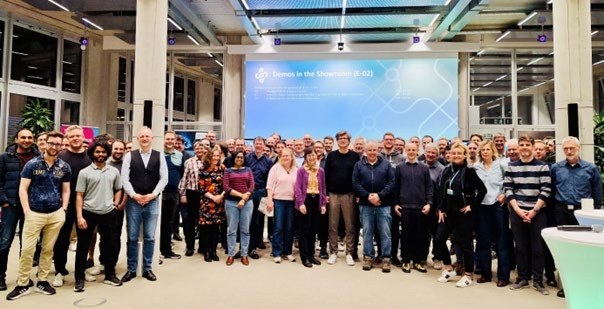
KliNet5G was part of the overarching BMWK-funded CampusOS framework. Over a period of three years, seven projects worked together to establish expertise in 5G campus networks in Germany, localize and validate prototypes, and increase the technological maturity of open and modular 5G campus network solutions. At the final event in March 2025, all projects came together to present and discuss their results.
More projects of the team
-
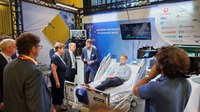 6G-Health Holistic development of high-performance 6G networking for distributed medical technology systems
High-performance 6G networking for distributed medical technology: in 2025 the infrastructure for tele-neuromonitoring, a testbed with three indoor localization technologies and a “patient room of the future” at the 6G Conference in Berlin were realized.
-
QoE Development of a system for Quality of Experience in telemedical data exchange
Quality of experience in telemedical data exchange: video, vital signs and ECG data are prioritized in real time based on network quality and the clinical context – for example in ambulances.
-
 SUSTAINET-guarDian Sustainable Technologies for Advanced Resilient and Energy-Efficient Networks – guided utilities for automation, resilience, and digital innovation in advanced networks
Secure, resilient and energy-efficient networks for healthcare with AI-supported network monitoring and fault detection; ICCAS is responsible for the medical demonstrator.
Back to the team Connected Health: Next-Generation Medical Networks