

SoKoRoMed
Soft and Continuum Robotics for Medical Applications
Soft and continuum robotics for medical applications: processes for producing patient- and application-specific soft end effectors. The reference use case is an actuated heart model as a training system for transcatheter aortic valve implantation (TAVI); first 3D-printed cardiac and vascular models and an ultrasound test bench for materials were developed and tested.
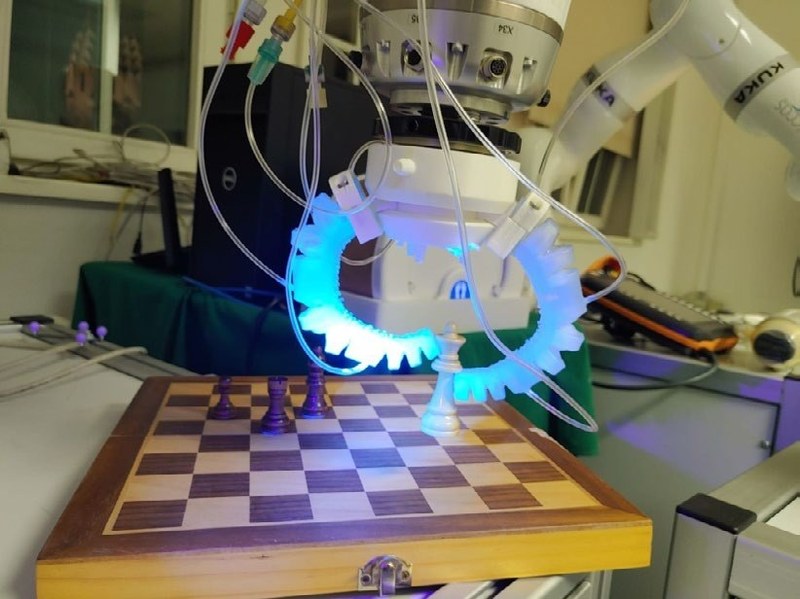
The “Soft and Continuum Robotics for Medical Applications (SoKoRoMed)” project aims to establish defined processes for the production of patient- and application-specific soft end effectors. In the project, soft end effectors are to be designed and used in combination with conventional medical and robotic technology in an overall clinical demonstrator for specific interventions. The definition of standards for the system and functional description of soft robots is intended to facilitate clinical translation. The project aims to develop strategies and procedures for the utilization and application of existing and new soft robotics technologies in the clinical environment.
A central reference use case is the development of an actuated heart model as a training system for transcatheter aortic valve implantation (TAVI), a minimally invasive procedure that demands a high degree of precision and adaptability. In collaboration with clinical partners, requirements (e.g. ultrasound compatibility and anatomical constraints) were defined and the first 3D-printed cardiac and vascular models were developed and tested. A specialized ultrasound test bench was set up to evaluate materials for their suitability for realistic medical imaging and sufficient actuation.
The project is currently focused on developing new materials and test environments, investigating silicones, hydrogels, and special additives to replicate mechanical properties and ultrasound characteristics close to human tissue. Additional test benches are developed to simulate heart muscle and valve functions. Future work will focus on the definition of a standardized workflow for patient- and application-specific tool manufacturing.